
What works: Health and care interventions for supporting young people not in education, employment, or training (NEET)

This evidence brief explores which health and care interventions can help young people stay in or return to education, employment or training, and the principles that can support effective practice.
What works: Health and care interventions for supporting young people not in education employment or training[PDF 599kb]
Download documentSummary
Almost one million people aged 16-24 in the UK were not in education, employment, or training (NEET) between October and December 2025, equivalent to around one in eight young people. However, the nature of youth disengagement is changing. Almost 60% of young people who are NEET are now economically inactive rather than unemployed, and six in ten have never had a job.
Health has become increasingly prominent: 44% of young people who were NEET reported a work-limiting health condition in 2025, compared with 26% in 2015. There is an increasing recognition that helping young people into employment, education or training requires focused support from health and care services. This evidence brief examines what health and care services can do to prevent or reduce health-related disengagement from education, employment, and training.
The strongest evidence is for integrated supported employment, particularly Individual Placement and Support (IPS) for young people with mental health conditions, which improves entry into competitive employment. The evidence for education and sustained participation is less consistent. Importantly, the evidence challenges the assumption that young people must first recover clinically or become “work ready” before receiving support with education or employment, underscoring that health and participation goals can be addressed concurrently.
Other approaches – including multidisciplinary vocational rehabilitation, personalised navigation, psychological support, and therapeutic or community-based vocational rehabilitation – may contribute to addressing a range of health, functional, and social challenges affecting participation. However, the evidence for their influence on EET outcomes is less established.
We identify five evidence-informed principles that support young people who are NEET into employment, education and training.
- Taking a life-course and transition-sensitive approach
- Providing youth-responsive services with meaningful youth participation
- Delivering integrated multi-sectoral support
- Addressing health and participation concurrently, rather than sequentially
- Focusing on functioning, participation, and wellbeing, not symptoms alone
Current challenges
Between October and December 2025, nearly one million 16-24-year-olds in the UK were not in education, employment, or training (NEET). The nature of young people’s disengagement from education and employment has changed substantially over the past decade. NEET is increasingly characterised by economic inactivity rather than unemployment: almost 60% of young people who are NEET are economically inactive, and six in ten have never been in employment, compared with four in ten two decades ago [1].
The health profile of young people who are NEET has also changed. The proportion of young people who are NEET reporting a work-limiting health condition increased from 26% in 2015 to 44% in 2025 [1]. The commonest health condition of young people who are NEET is mental health problems (20%, 455,414 people), followed by learning difficulties including autism (12%, 315,248 people). There has been a particular rise in young people who are NEET with mental health conditions and learning difficulties (Figure 1).
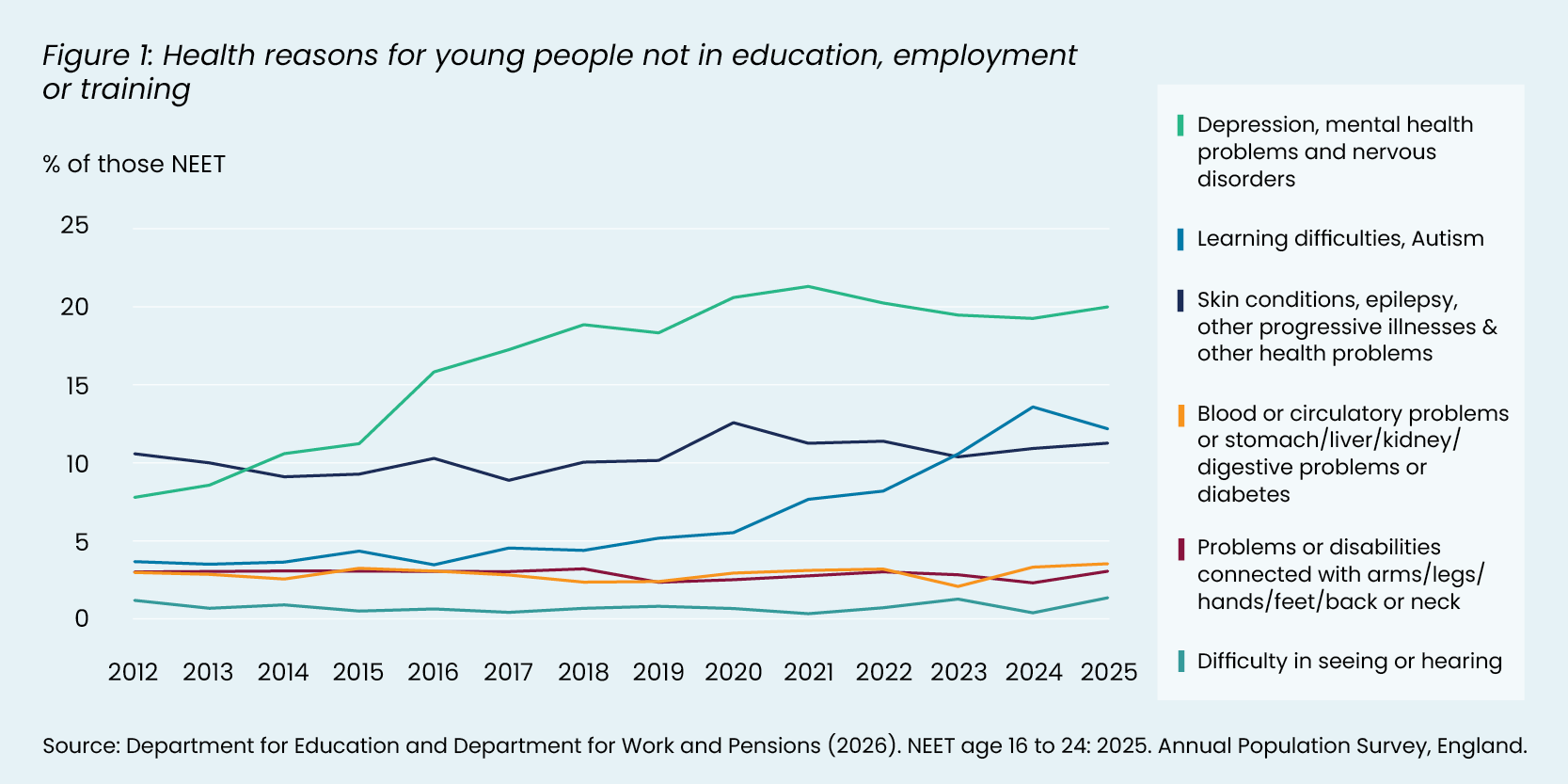
Poor health is both an important predictor of vocational disengagement and part of a wider pattern of disadvantage associated with NEET [1]. Across countries and settings, young people who are NEET report higher levels of mental ill health, psychological distress, and substance use when compared to their peers who are in education or employment [2][3][4][5][6][7][8][9][10]. Conversely, studies of youth mental health services have found depression, functional impairment, and more severe or complex mental health needs to be associated with vocational disengagement [11][12][13].
Longitudinal evidence provides stronger support for poor health contributing to later disengagement than for a simple causal pathway in the opposite direction. Adolescent mental health and behavioural difficulties have been associated with subsequent NEET status and poorer educational and employment outcomes [14][15][16][17]. Among help-seeking young adults, the course of depression and functional disability has similarly been associated with subsequent NEET status [18]. A systematic review and meta-analysis concluded that mental health problems and substance use are associated with NEET status, with longitudinal evidence more consistently supporting mental ill health preceding NEET than NEET causing subsequent mental ill health [19]. Longitudinal studies indicate that periods of disengagement can coexist with, and potentially contribute to, continuing mental health and socioeconomic disadvantage into early adulthood [20][21].
Importantly, these relationships are also unequal. Studies identify differences according to socioeconomic circumstances, educational attainment, family and childhood circumstances, health and disability, and other forms of disadvantage [22][23][24][25][26][27]. In the UK, disabled young people are substantially more likely to be NEET than their non-disabled peers, while young people from lower-income backgrounds, facing educational or family challenges, or living in deprived areas are more likely to be NEET than their peers [1][23][28][29]. Thus, NEET should be understood as a status that can arise through different pathways, rather than a single health or employment problem.
National and local policymakers are increasingly recognising that supporting young people into employment, education or training requires a joined-up approach across the labour market, education and health. Here we examine health and care interventions which prevent or reduce health-related disengagement from education, employment and training.
Summary of evidence
Overall, the evidence was considered across two complementary bodies of literature: direct evidence on interventions for young people who were NEET or vocationally disengaged, and broader evidence on health and care interventions supporting young people with health conditions which reported outcomes on employment or education. Evidence relating specifically to neurodiversity, work, and health in the wider population is synthesised in a separate complementary evidence brief.
We identified 181 potentially relevant studies and evidence sources through Health Equity Evidence Centre work and health living evidence maps, Google Scholar, snowball searching, and grey literature searches. Of this, we prioritised 58 studies that were the most relevant to understanding how health and care interventions might support young people’s participation in education, employment, or training. The Living Evidence Maps provided the direct evidence relating to NEET within their scope, while supplementary searches were used to identify a broader body of relevant health-adjacent literature examining EET outcomes among young people.
Intervention approaches
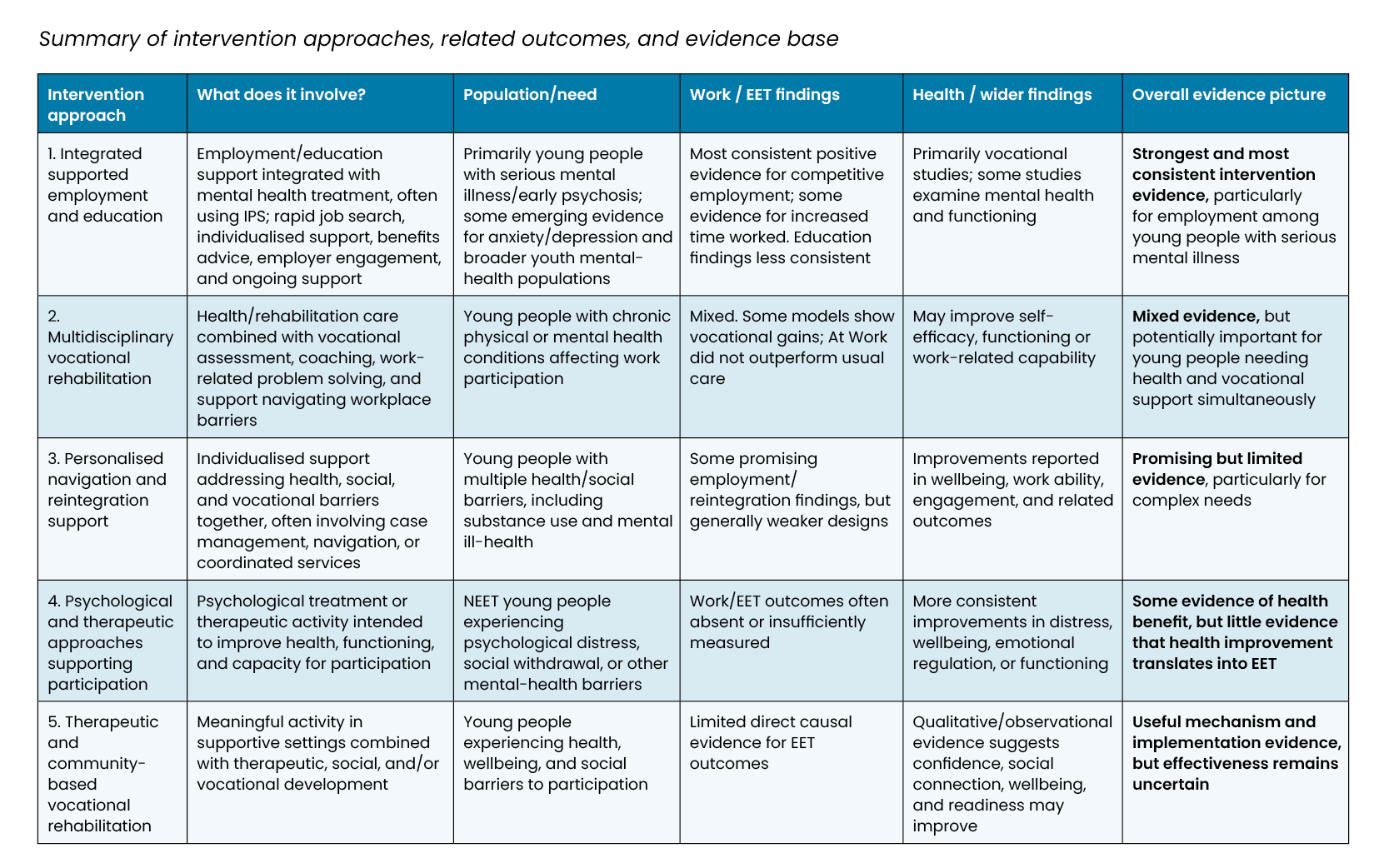
The evidence includes a diverse range of approaches through which health and care services may support young people whose health affects their participation in employment, education, or training. We grouped the interventions into five broad categories according to their primary intervention approach and intended pathway to participation. These categories overlap, and some interventions contain components relevant to more than one intervention approach.
The main distinction lies in where each approach intervenes in the pathway between health and participation. Integrated supported employment and education, including Individual Placement and Support (IPS), embeds vocational support within healthcare and addresses health and EET concurrently; whereas multidisciplinary vocational rehabilitation focuses more explicitly on the functional consequences of physical or mental health conditions on an individual’s work or education. Personalised navigation and reintegration support coordinates access to services where multiple health, social, and practical barriers interact, usually provided by a case manager or coordinator to help an individual navigate services. Psychological and therapeutic approaches primarily focus on supporting individual mental health and wellbeing where it may constrain participation in work or education, while therapeutic and community-based rehabilitation uses meaningful activity and supportive environments, such as structured group-based and community activities, as a bridge towards wider participation.
1. Integrated supported employment and education
Integrated supported employment approaches address health and vocational participation concurrently, rather than treating employment as something to consider only after clinical recovery. The most established model in the evidence is Individual Placement and Support (IPS), which integrates employment specialists within mental health services and combines rapid job search with individualised support, employer engagement, and ongoing assistance once a person enters work.
Across systematic reviews of vocational interventions for young people with mental health conditions, IPS has produced the most consistent evidence of improved competitive employment [30][31][32][33]. The evidence is strongest among young people experiencing serious mental illness or early psychosis, while also highlighting considerable variation in how employment outcomes were defined and measured [34]. More recent evidence suggests that IPS can also be implemented in routine mental health services. Bond et al [35] followed young adults aged 16-24 receiving IPS in public mental health services and found that 45.9% obtained competitive employment or a paid internship during the first year, while 12.6% achieved new education outcomes.
Evidence from Norway also suggests that IPS can operate across health and welfare systems. For instance, Brinchmann et al [36] examined implementation among young adults receiving temporary health-related welfare benefits and found an increase in employment following implementation, with effects increasing over three years. The model has also been adapted to young people’s wider vocational trajectories. Ellison et al [37] incorporated supported education, near-age peer mentoring, career development, and benefits counselling within an IPS-informed programme for emerging adults with serious mental health conditions. Simmons et al [38] similarly combined IPS with vocational peer work within integrated youth mental health services for young people aged 15-25.
Overall, this literature provides the strongest evidence in the review that employment support integrated with healthcare can improve employment outcomes, particularly among young people receiving mental healthcare. Evidence for education and long-term participation remains limited.
2. Multidisciplinary vocational rehabilitation
Multidisciplinary vocational rehabilitation similarly brings health and employment support together but focuses more explicitly on the functional consequences of a health condition and the barriers these create for participation. Interventions can combine health or psychological support with vocational assessment, skills development, work preparation, and individualised support towards employment.
Evidence for this approach is more heterogeneous than for IPS. Reviews of NEET interventions identify multicomponent approaches combining vocational support with health, psychological, educational, or social components, but substantial variation in intervention design and outcome measurement makes it difficult to determine which components are responsible for effects [30][31][39]. For example, Crespo-Andrade et al [40] evaluated a multicomponent programme for marginalised unemployed young people in Latin America that combined support across several domains and reported improvements in emotional and cognitive outcomes. Overall, the evidence supports addressing multiple barriers to participation but provides less certainty about the effectiveness of a distinct multidisciplinary vocational rehabilitation model.
3. Personalised navigation and reintegration support
A third group of interventions responds to vocational disengagement as the result of multiple interacting health, social, and practical barriers that may not be amenable to a single clinical or employment intervention. These approaches tend to provide flexible, individualised support that helps young people navigate services, address barriers and reconnect with employment, education, and other forms of participation. For example, in the COPE programme evaluated by Bertotti et al [41], support was deliberately flexible and community-based, with practitioners responding to young people’s wider circumstances over delivering a narrowly clinical intervention. Qualitative findings emphasised emotional support, trust, and flexibility alongside opportunities to build confidence, develop skills, and become more active.
Similarly, De Lannoy et al [42] evaluated a holistic coaching and referral programme designed to improve wellbeing and employability among young people who were NEET. These approaches reflect a broader theme in the intervention literature: programmes appear more responsive to heterogeneous NEET populations when support is tailored to individual circumstances and can connect young people with different forms of provision [39]. However, evidence for navigation and reintegration remains limited, particularly in comparison with supported employment. The available studies are more useful for understanding how personalised and coordinated support might operate than for establishing comparative effectiveness.
4. Psychological and therapeutic approaches supporting participation
Some interventions focus primarily on the health and psychological barriers associated with vocational disengagement, rather than providing direct employment support. These include psychotherapy, mindfulness, and psychological skills programmes delivered to young people who are NEET or experiencing substantial barriers to participation.
For example, Lee et al [43] evaluated a home visitation programme for socially withdrawn young people, while Roemer et al [44] examined a mindfulness-based intervention for young unemployed adults within a residential youth development programme and measured psychological distress, wellbeing, and mindfulness. Anestis et al [45] evaluated Dialectical Behaviour Therapy skills training among at-risk young men in a residential programme, and Buckman et al [46] examined psychological therapy outcomes among young adults who were NEET. Other included studies have evaluated multicomponent interventions targeting psychological and social functioning among marginalised or socially withdrawn young people [40][47][48][49].
Across this literature, psychological distress, wellbeing, emotional regulation, and functioning are more consistently measured than subsequent employment or education. A rapid evidence review commissioned by Public Health Wales [50] similarly found some evidence of improvements in mental and emotional health and wellbeing, but highlighted the limited quality of the underlying evidence and inconsistent measurement of EET outcomes. These interventions therefore provide evidence about addressing health-related barriers associated with NEET, but considerably less evidence that improvements in health alone produce sustained vocational re-engagement.
5. Therapeutic and community-based vocational rehabilitation
Finally, some approaches use meaningful activity and supportive environments themselves as part of the pathway towards vocational participation. Rather than moving immediately into formal job search, young people participate in structured activities through which they can rebuild routines, relationships, confidence, and practical or social skills [51][52][53][54][55].
For example, Ørjasæter [51] examined art-based vocational support for emerging adults who were NEET, with participants and staff emphasising individually tailored support, supportive relationships, peer interaction, and an appropriate balance between demands and support. Grow2Grow combined mental health and vocational support through horticultural activity outside conventional clinical settings [56], while Down to Earth used sustainable construction activities with disadvantaged and hard-to-reach groups and examined mental health and social connection [27]. Similarly, Kendall and Maujean [52] evaluated an equine-assisted psychological intervention for disengaged young people.
These studies suggest several plausible pathways through which structured community activity might support movement towards participation, including improvements in confidence, social connection, wellbeing, skills, and engagement. However, the evidence for subsequent entry into or sustained participation in EET is considerably less developed. These outcomes should therefore be understood as potential mechanisms or intermediate outcomes, rather than evidence that community-based therapeutic activity itself improves EET participation.
Evidence-informed principles for supporting young people into employment, education and training
Several common principles emerge across the studies. These principles describe how health and care services might organise support around young people’s participation in education and employment, rather than specifying a single intervention that should be implemented for all young people who are NEET.
| 1. Taking a life-course and transition-sensitive approach |
| 2. Providing youth-responsive services with meaningful youth participation |
| 3. Delivering integrated, multisectoral support |
| 4. Addressing health and participation concurrently, rather than sequentially |
| 5. Focusing on functioning, participation and wellbeing, not symptoms alone |
Principle 1: Taking a life-course and transition-sensitive approach
Support for education and employment should reflect the distinctive developmental stage of adolescence and emerging adulthood, rather than simply adapting adult employment programmes for younger populations. Young people’s vocational trajectories are rarely linear: education, training, first employment, changes in career aspirations, periods of ill health, and transitions between services may occur concurrently. This means that preventing long-term disengagement requires attention both to early intervention and to continuity through transitions.
The wider evidence supports taking a longitudinal view of these trajectories. Mental health and behavioural difficulties during adolescence are associated with subsequent NEET status and poorer education and employment outcomes [14][15][16][17][37], while studies of young people receiving mental healthcare similarly show that health, functioning, education, and employment can change together over time [18]. Intervention reviews also highlight the importance of approaches that accommodate both education and employment during this developmental period rather than treating employment as the only vocational outcome [30][31].
Overall, a life-course perspective suggests looking beyond whether a young person enters employment at a single time point towards whether services support participation across changing educational, employment, and health circumstances.
Principle 2: Providing youth-responsive services with meaningful youth participation
Services should be responsive to young people’s developmental stage, circumstances, priorities, and changing education and employment goals. This may require provision that differs from conventional adult employment support, including greater attention to education, emerging vocational goals, social relationships, and the wider circumstances influencing participation. Across the intervention literature, personalised and flexible approaches recur in programmes working with heterogeneous groups of young people who are NEET or experiencing health-related barriers to participation [37][38][39][42][51][57].
Youth-responsive provision should be distinguished from youth participation in service design. The former adapts support around the circumstances of young people [54][55][57][58]; the latter involves young people themselves in shaping what support looks like and how decisions are made [59][60][61]. A systematic review of theories, models, and frameworks for youth engagement in health research found that meaningful engagement encompasses questions of power and decision-making, process, impact, and equity [62]. Equity-focused frameworks particularly emphasised young people’s perspectives and local knowledge alongside attention to social determinants and structural conditions.
This distinction is relevant to NEET because young people’s experiences can identify barriers and priorities that may not be captured through clinical or employability measures alone. Qualitative evidence from vocational support similarly highlights the importance young people place on individually tailored provision, supportive relationships, peer interaction, and an appropriate balance between support and challenge [51]. Meaningful youth participation may therefore help services identify barriers, define relevant outcomes, and design provision that better reflects how young people experience health, education, and employment.
Principle 3: Delivering integrated, multisectoral support
Health-related vocational disengagement often cuts across the responsibilities of healthcare, education, employment, and welfare services, such that support may be weakened when young people are expected to navigate these systems independently. The evidence includes several approaches in which health and vocational expertise are brought together around the young person rather than provided sequentially or in isolation.
IPS provides the clearest example of this integration. Brinchmann et al [36] examined cross-sector implementation involving mental health services and the Norwegian Labour and Welfare Administration among young adults receiving temporary health-related welfare benefits, finding increased employment following implementation. Bond et al [32] similarly examined IPS delivered within routine public mental health services for young adults, demonstrating how vocational support can be incorporated into existing mental healthcare. Beyond IPS, holistic and personalised approaches combine or coordinate support across health, social, educational, and employment-related needs [39][42].
Taken together, these studies suggest that integration is better understood as a function than a single organisational model: the relevant services and expertise will vary according to young people’s needs, but health and participation goals should not be addressed in disconnected systems.
Principle 4: Address health and participation concurrently, rather than sequentially
The strongest intervention evidence challenges a sequential approach in which young people are expected to first achieve clinical recovery or become “work ready” before support with education or employment begins. Instead, health treatment and vocational support can be delivered concurrently, allowing education or employment goals to be addressed as part of care rather than deferred until treatment has ended.
This principle is central to IPS, where employment support is integrated with mental health treatment rather than preceded by prolonged pre-vocational preparation. Systematic reviews and randomised studies of interventions for young people with mental health conditions consistently identify IPS as one of the better-supported approaches for improving competitive employment [30][31][63][64]. Evidence from routine implementation similarly demonstrates that vocational support can be delivered within or alongside mental health services [32][36].
Nevertheless, concurrent support should not be interpreted as employment-first support for everyone. Some young people may require more gradual or intensive health, social, or rehabilitative support. The broader implication is that services should avoid creating an unnecessary sequential pathway in which vocational aspirations are automatically deferred because a young person is receiving treatment.
Principle 5: Focus on functioning, participation, and wellbeing, not symptoms alone
Health outcomes and vocational outcomes should not be treated as interchangeable. Improving symptoms, psychological wellbeing, or functioning may be valuable outcomes in themselves, but does not demonstrate that a young person has entered or sustained participation in EET. Conversely, obtaining employment does not by itself establish that health, functioning, or longer-term participation has improved.
This distinction is visible across the intervention evidence. Psychological and therapeutic interventions have reported improvements in outcomes such as distress, emotional regulation, wellbeing, and functioning without consistently establishing subsequent EET participation [40][43][44][45][50]. Conversely, supported employment studies primarily demonstrate vocational outcomes, while providing less evidence about longer-term health and participation [31][32]. The evidence therefore does not support assuming that improvement in one domain necessarily produces improvement in the other.
Where supporting EET is an intended goal of health and care, health, functioning, and participation should therefore be considered and measured as related but distinct outcomes, including whether participation can be sustained over time.
Recommendations
| Recommendation | Target audience | GRADE certainty |
| Integrate national health, education and employment policy focused on sustained participation | National government | ⊕ ⊕ ⊕ Moderate |
| Focus on sustained participation and minimising dropout at the transition out of full-time education as the main objective and measured outcome, rather than job entry | National government, Integrated Care Boards and local authorities | ⊕ ⊕ ⊕ Moderate |
| Ensure that adult services are adapted for young people through co-design, particularly with those who are currently underserved | National government, Integrated Care Boards and local authorities | ⊕ ⊕ ⊕ Moderate |
| Where possible, offer health and employment support concurrently through integrated, multidisciplinary services | Integrated Care Boards, Health and care organisations, such as general practice and mental health services | ⊕ ⊕ ⊕ Moderate |
| Prioritise Individual Placement and Support for young people with serious mental health conditions | Integrated Care Boards | ⊕ ⊕ ⊕ Moderate |
| Consider targeting multidisciplinary rehabilitation and navigation for those needing support with physical health conditions or with particularly complex social needs | Integrated Care Boards | ⊕ ⊕ Low |
| Include discussions of education, training and employment goals routinely as part of health and care contact | Health and care organisations, such as general practice and mental health services | ⊕ ⊕ ⊕ Moderate |
| Focus on functional goals, alongside symptoms, in health and care services supporting young people who are NEET | Health and care organisations, such as general practice and mental health services | ⊕ ⊕ ⊕ Moderate |
| Agree individual support plans for transitions between adolescent and adult services | Health and care organisations, such as general practice and mental health services | ⊕ ⊕ Low |
| Consider community-based therapeutic activities for young people who are NEET focused on bridging to work, especially when immediate employment is not appropriate | Integrated Care Boards and local authorities | ⊕ ⊕ Low |
| More evidence is required on how the effectiveness of services varies across key population groups, such as gender, ethnicity, disability and health conditions | Research funders and commissioners of service evaluations | Not applicable |
*GRADE certainty communicates the strength of evidence for each recommendation.
Recommendations which are supported by large trials will be graded highest, whereas those arising from small studies or transferable evidence will be graded lower. The grading should not be interpreted as a priority for policy implementation – i.e. some recommendations may have a low GRADE rating but be likely to make a substantial population impact.
Limitations
The evidence base has several important limitations. First, the literature was heterogeneous in populations, interventions, settings, and outcomes, making direct comparison between approaches difficult. Employment outcomes were considerably more commonly reported than health outcomes, and relatively few studies examined education, training, sustained participation, or the relationship between changes in health and changes in EET participation. The strongest intervention evidence was also concentrated in particular clinical populations, especially young people with serious mental illness or early psychosis. Evidence was more limited for other health conditions and for interventions aimed at preventing disengagement before a young person becomes NEET. These limitations are reflected in the GRADE certainty assessments, particularly through indirectness and imprecision.
Second, there was limited evidence from an equity perspective. Although wider research indicates that the risk of becoming NEET is socially patterned, the intervention literature rarely examined whether access, engagement, effectiveness, or sustained outcomes differed by socioeconomic circumstances, ethnicity, disability, migration status, gender, or other dimensions of inequality. Much of the stronger effectiveness evidence also concerned young people already engaged with specialist health services, providing less insight into young people who do not meet service thresholds or experience barriers to accessing care. The absence of differential-effect evidence limits conclusions about whether interventions that are effective overall also reduce, maintain, or widen inequalities in EET participation.
Finally, NEET remains a relatively new framing within health and care research. Relevant interventions have often been described using other concepts, including vocational rehabilitation, supported employment, work participation, occupational functioning, and return to work, rather than NEET terminology. This creates challenges for identifying and defining the evidence base and means that relevant studies may not be readily captured through NEET-focused searches alone. At the same time, growing policy and research attention to health-related economic inactivity among young people means this is a rapidly developing field. The findings of this brief should therefore be understood as a current synthesis of an emerging evidence base, which is likely to expand as more research explicitly examines health, NEET, and participation in education and employment together.
How this brief was produced
We identified 181 potentially relevant studies and evidence sources through the Health Equity Evidence Centre’s work and health Living Evidence Maps, Google Scholar, snowball searching and grey literature searches. Of these, we prioritised 58 studies that were most relevant to understanding how health and care interventions might support young people’s participation in education, employment or training.
The Living Evidence Maps provided direct evidence relating to NEET within their scope, while supplementary searches identified a broader body of relevant health-adjacent literature examining education, employment and training outcomes among young people.
Suggested citation
Sanchez S, Dudley D and Ford J. Evidence brief: What works – Health and care interventions for supporting young people not in education, employment, or training (NEET). Health Equity Evidence Centre; 2026
References
- Milburn A. Young people and work: interim report [Internet]. Department for Work and Pensions; 2026 May [cited 2026 Sept 17].
Available from: https://assets.publishing.service.gov.uk/media/6a3111dec39255c595b50928/Young_people_and_work_interim_report.pdf - Stea TH, Abildsnes E, Strandheim A, Haugland SH. Do young people who are not in education, employment or training (NEET) have more health problems than their peers? A cross-sectional study among Norwegian adolescents. Nor Epidemiol [Internet]. 2019 May 9;28(1–2).
Available from: http://dx.doi.org/10.5324/nje.v28i1-2.3055 - Benjet C, Hernández-Montoya D, Borges G, Méndez E, Medina-Mora ME, Aguilar-Gaxiola S. Youth who neither study nor work: mental health, education and employment. Salud Publica Mex [Internet]. 2012 July;54(4):410–7.
Available from: http://dx.doi.org/10.1590/s0036-36342012000400011 - Baggio S, Iglesias K, Deline S, Studer J, Henchoz Y, Mohler-Kuo M, et al. Not in Education, Employment, or Training status among young Swiss men. Longitudinal associations with mental health and substance use. J Adolesc Health [Internet]. 2015 Feb;56(2):238–43
Available from: http://dx.doi.org/10.1016/j.jadohealth.2014.09.006 - Henderson JL, Hawke LD, Chaim G. Not in employment, education or training: Mental health, substance use, and disengagement in a multi-sectoral sample of service-seeking Canadian youth. Child Youth Serv Rev [Internet]. 2017 Apr;75:138–45.
Available from: http://dx.doi.org/10.1016/j.childyouth.2017.02.024 - Basta M, Karakonstantis S, Koutra K, Dafermos V, Papargiris A, Drakaki M, et al. NEET status among young Greeks: Association with mental health and substance use. J Affect Disord [Internet]. 2019 June 15;253:210–7.
Available from: http://dx.doi.org/10.1016/j.jad.2019.04.095 - Gariépy G, Iyer S. The Mental Health of young Canadians who are not working or in school. Can J Psychiatry [Internet]. 2019 May;64(5):338–44.
Available from: http://dx.doi.org/10.1177/0706743718815899 - Nardi B, Arimatea E, Giunto P, Lucarelli C, Nocella S, Bellantuono C. Not Employed in Education or Training (NEET) adolescents with unlawful behaviour: an observational study. Official Journal of the Italian Society of Psychopathology [Internet]. 2013 Mar 6 [cited 2026 Sept 17];19:42–8.
Available from: https://old.jpsychopathol.it/wp-content/uploads/2015/07/07Nardi1.pdf - Nardi B, Lucarelli C, Talamonti M, Arimatea E, Fiori V, Moltedo-Perfetti A. NEETs versus EETs: an observational study in Italy on the framework of the HEALTH25 European project. Res Post-compuls Educ [Internet]. 2015 Oct 2;20(4):377–99.
Available from: http://dx.doi.org/10.1080/13596748.2015.1081749 - Manhica H, Lundin A, Danielsson AK. Not in education, employment, or training (NEET) and risk of alcohol use disorder: a nationwide register-linkage study with 485 839 Swedish youths. BMJ Open [Internet]. 2019 Oct 14;9(10):e032888.
Available from: http://dx.doi.org/10.1136/bmjopen-2019-032888 - O’Dea B, Glozier N, Purcell R, McGorry PD, Scott J, Feilds KL, et al. A cross-sectional exploration of the clinical characteristics of disengaged (NEET) young people in primary mental healthcare. BMJ Open [Internet]. 2014 Dec 23;4(12):e006378.
Available from: http://dx.doi.org/10.1136/bmjopen-2014-006378 - Caruana E, Allott K, Farhall J, Parrish EM, Davey CG, Chanen AM, et al. Factors associated with vocational disengagement among young people entering mental health treatment. Early Interv Psychiatry [Internet]. 2019 Aug;13(4):961–8.
Available from: http://dx.doi.org/10.1111/eip.12718 - Cairns AJ, Kavanagh DJ, Dark F, McPhail SM. Comparing predictors of part-time and no vocational engagement in youth primary mental health services: A brief report. Early Interv Psychiatry [Internet]. 2018 Aug;12(4):726–9.
Available from: http://dx.doi.org/10.1111/eip.12445 - Rodwell L, Romaniuk H, Nilsen W, Carlin JB, Lee KJ, Patton GC. Adolescent mental health and behavioural predictors of being NEET: a prospective study of young adults not in employment, education, or training. Psychol Med [Internet]. 2018 Apr;48(5):861–71.
Available from: http://dx.doi.org/10.1017/S0033291717002434 - Hale DR, Viner RM. How adolescent health influences education and employment: investigating longitudinal associations and mechanisms. J Epidemiol Community Health [Internet]. 2018 June;72(6):465–70.
Available from: http://dx.doi.org/10.1136/jech-2017-209605 - Hammerton G, Murray J, Maughan B, Barros FC, Gonçalves H, Menezes AMB, et al. Childhood behavioural problems and adverse outcomes in early adulthood: A comparison of Brazilian and British birth cohorts. J Dev Life Course Criminol [Internet]. 2019 Oct 27;5(4):517–35.
Available from: http://dx.doi.org/10.1007/s40865-019-00126-3 - López-López JA, Kwong ASF, Washbrook E, Pearson RM, Tilling K, Fazel MS, et al. Trajectories of depressive symptoms and adult educational and employment outcomes. BJPsych Open [Internet]. 2019 Dec 12;6(1):e6.
Available from: http://dx.doi.org/10.1192/bjo.2019.90 - O’Dea B, Lee RSC, McGorry PD, Hickie IB, Scott J, Hermens DF, et al. A prospective cohort study of depression course, functional disability, and NEET status in help-seeking young adults. Soc Psychiatry Psychiatr Epidemiol [Internet]. 2016 Oct;51(10):1395–404.
Available from: http://dx.doi.org/10.1007/s00127-016-1272-x - Gariépy G, Danna SM, Hawke L, Henderson J, Iyer SN. The mental health of young people who are not in education, employment, or training: a systematic review and meta-analysis. Soc Psychiatry Psychiatr Epidemiol [Internet]. 2022 June;57(6):1107–21.
Available from: http://dx.doi.org/10.1007/s00127-021-02212-8 - Power E, Clarke M, Kelleher I, Coughlan H, Lynch F, Connor D, et al. The association between economic inactivity and mental health among young people: a longitudinal study of young adults who are not in employment, education or training. Ir J Psychol Med [Internet]. 2015 Mar;32(1):155–60.
Available from: http://dx.doi.org/10.1017/ipm.2014.85 - Gutiérrez-García RA, Benjet C, Borges G, Méndez Ríos E, Medina-Mora ME. NEET adolescents grown up: eight-year longitudinal follow-up of education, employment and mental health from adolescence to early adulthood in Mexico City. Eur Child Adolesc Psychiatry [Internet]. 2017 Dec;26(12):1459–69.
Available from: http://dx.doi.org/10.1007/s00787-017-1004-0 - Bynner J, Parsons S. Social exclusion and the transition from school to work: The case of young people not in education, employment, or training (NEET). J Vocat Behav [Internet]. 2002 Apr;60(2):289–309.
Available from: http://dx.doi.org/10.1006/jvbe.2001.1868 - Goldman-Mellor S, Caspi A, Arseneault L, Ajala N, Ambler A, Danese A, et al. Committed to work but vulnerable: self-perceptions and mental health in NEET 18-year olds from a contemporary British cohort. J Child Psychol Psychiatry [Internet]. 2016 Feb;57(2):196–203.
Available from: http://dx.doi.org/10.1111/jcpp.12459 - Bania EV, Eckhoff C, Kvernmo S. Not engaged in education, employment or training (NEET) in an Arctic sociocultural context: the NAAHS cohort study. BMJ Open [Internet]. 2019 Mar 23;9(3):e023705.
Available from: http://dx.doi.org/10.1136/bmjopen-2018-023705 - Gunnes M, Thaulow K, Kaspersen SL, Jensen C, Ose SO. Young adults not in education, employment, or training (NEET): a global scoping review. BMC Public Health [Internet]. 2025 Oct 8;25(1):3394.
Available from: http://dx.doi.org/10.1186/s12889-025-24781-y - of-school time program on social-emotional learning among disadvantaged adolescent youth: A retrospective analysis. Child Youth Serv Rev [Internet]. 2021 Dec;131(106262):106262.
Available from: http://dx.doi.org/10.1016/j.childyouth.2021.106262 - Davies J, McKenna M, Bayley J, Denner K, Young H. Using engagement in sustainable construction to improve mental health and social connection in disadvantaged and hard to reach groups: a new green care approach. J Ment Health [Internet]. 2020 June;29(3):350–7.
Available from: http://dx.doi.org/10.1080/09638237.2020.1714001 - Rahmani H, Groot W, Rahmani AM. Unravelling the NEET phenomenon: a systematic literature review and meta-analysis of risk factors for youth not in education, employment, or training. Int J Adolesc Youth [Internet]. 2024 Dec 31;29(1).
Available from: http://dx.doi.org/10.1080/02673843.2024.2331576 - Lindblad V, Lund RL, Gaardsted PS, Møller Hansen LE, Lauritzen FF, Melgaard D. Place matters: Understanding geographic influences on youth not in education, employment, or training-A scoping review. J Adolesc [Internet]. 2025 Apr;97(3):620–33.
Available from: http://dx.doi.org/10.1002/jad.12461 - Mawn L, Oliver EJ, Akhter N, Bambra CL, Torgerson C, Bridle C, et al. Are we failing young people not in employment, education or training (NEETs)? A systematic review and meta-analysis of re-engagement interventions. Syst Rev [Internet]. 2017 Jan 25;6(1):16.
Available from: http://dx.doi.org/10.1186/s13643-016-0394-2 - Stea TH, Bertelsen TB, Fegran L, Sejersted E, Kleppang AL, Fyhn T. Interventions targeting young people not in employment, education or training (NEET) for increased likelihood of return to school or employment-A systematic review. PLoS One [Internet]. 2024 June 27;19(6):e0306285.
Available from: http://dx.doi.org/10.1371/journal.pone.0306285 - Bond GR, Swanson SJ, Becker DR, Al-Abdulmunem M, Ressler DR, Marbacher J. Individual placement and support for young adults: One-year outcomes. Psychiatr Rehabil J [Internet]. 2024 Mar;47(1):46–55.
Available from: http://dx.doi.org/10.1037/prj0000580 - Pelizza L, Ficarelli ML, Vignali E, Artoni S, Franzini MC, Montanaro S, et al. Individual placement and support in Italian young adults with mental disorder: Findings from the Reggio Emilia experience. Early Interv Psychiatry [Internet]. 2020 Oct;14(5):577–86.
Available from: http://dx.doi.org/10.1111/eip.12883 - Aguey-Zinsou M, Scanlan JN, Cusick A. A scoping and systematic review of employment processes and outcomes for young adults experiencing psychosis. Community Ment Health J [Internet]. 2023 May;59(4):728–55.
Available from: http://dx.doi.org/10.1007/s10597-022-01056-z - Bond GR, Al-Abdulmunem M, Marbacher J, Christensen TN, Sveinsdottir V, Drake RE. A systematic review and meta-analysis of IPS supported employment for young adults with mental health conditions. Adm Policy Ment Health [Internet]. 2023 Jan;50(1):160–72.
Available from: http://dx.doi.org/10.1007/s10488-022-01228-9 - Brinchmann B, Wittlund S, Lorentzen T, Moe C, McDaid D, Killackey E, et al. The societal impact of individual placement and support implementation on employment outcomes for young adults receiving temporary health-related welfare benefits: a difference-in-differences study. Psychol Med [Internet]. 2024 June;54(8):1787–95.
Available from: http://dx.doi.org/10.1017/S0033291723003744 - Ellison ML, Klodnick VV, Bond GR, Krzos IM, Kaiser SM, Fagan MA, et al. Adapting supported employment for emerging adults with serious mental health conditions. J Behav Health Serv Res [Internet]. 2015 Apr;42(2):206–22.
Available from: http://dx.doi.org/10.1007/s11414-014-9445-4 - Simmons MB, Chinnery G, Whitson S, Bostock S, Braybrook J, Hamilton M, et al. Implementing a combined individual placement and support and vocational peer work program in integrated youth mental health settings. Early Interv Psychiatry [Internet]. 2023 Apr;17(4):412–21.
Available from: http://dx.doi.org/10.1111/eip.13387 - Marques MJ, Alves RF, Dias S, Torri E, Paza A, Dantas C, et al. A realist synthesis of interventions for youth not in education, employment or training (NEET): building programme theories for effective support. Int J Adolesc Youth [Internet]. 2025 Dec 31;30(1).
Available from: http://dx.doi.org/10.1080/02673843.2025.2472022 - ponent intervention associated with improved emotional and cognitive outcomes of marginalized unemployed youth of Latin America. Soc Sci (Basel) [Internet]. 2022 Apr 1;11(4):155.
Available from: http://dx.doi.org/10.3390/socsci11040155 - Bertotti M, Farina I, Marques MJ, Alves R, Dias S, Paternoster S, et al. Social prescribing for Not in Employment, Education or Training (NEET) young people: A realist evaluation of the C.O.P.E. project in Italy and Portugal. SSM Ment Health [Internet]. 2025 June;7(100440):100440.
Available from: http://dx.doi.org/10.1016/j.ssmmh.2025.100440 - De Lannoy A, Graham L, Grotte J, Mthembu S, Ralarala D, Tatham C. Can A holistic coaching and referral programme enhance well-being and employability amongst NEET youth? [Internet]. 2026.
Available from: http://dx.doi.org/10.2139/ssrn.6181647 - Lee YS, Lee JY, Choi TY, Choi JT. Home visitation program for detecting, evaluating and treating socially withdrawn youth in Korea. Psychiatry Clin Neurosci [Internet]. 2013 May;67(4):193–202.
Available from: http://dx.doi.org/10.1111/pcn.12043 - Roemer A, Sutton A, Grimm C, Medvedev ON. Effectiveness of a low-dose mindfulness-based intervention for alleviating distress in young unemployed adults. Stress Health [Internet]. 2021 Apr;37(2):320–8.
Available from: http://dx.doi.org/10.1002/smi.2997 - Anestis JC, Charles NE, Lee-Rowland LM, Barry CT, Gratz KL. Implementing dialectical behavior therapy skills training with at-risk male youth in a military-style residential program. Cogn Behav Pract [Internet]. 2020 May;27(2):169–83.
Available from: http://dx.doi.org/10.1016/j.cbpra.2019.07.001 - Buckman JEJ, Stott J, Main N, Antonie DM, Singh S, Naqvi SA, et al. Understanding the psychological therapy treatment outcomes for young adults who are not in education, employment, or training (NEET), moderators of outcomes, and what might be done to improve them. Psychol Med [Internet]. 2023 May;53(7):2808–19.
Available from: http://dx.doi.org/10.1017/S0033291721004773 - Wong PWC, Yu RWM, Li TMH, Lai SLH, Ng HYH, Fan WTW. Efficacy of a multicomponent intervention with animal-assisted therapy for socially withdrawn youth in Hong Kong. Soc Anim [Internet]. 2019 Oct 15;27(5–6):614–27.
Available from: http://dx.doi.org/10.1163/15685306-12341462 - Wong PWC, Su X, Yu RWM, Li TMH. Reengaging youth with prolonged social withdrawal behaviours in Hong Kong: Efficacy of an intervention programme involving human and non-human partners. Child Youth Serv [Internet]. 2023 July 3;44(3):231–49.
Available from: http://dx.doi.org/10.1080/0145935x.2022.2100756 - Measuring psychological support for the unemployed: The case of kakao NEET project. KSII Trans Internet Inf Syst [Internet]. 2021 Apr 30;15(4).
Available from: http://dx.doi.org/10.3837/tiis.2021.04.017 - Wale A, Khatoon S, Morgan C, Fox-McNally A, Morgan H, Little K, et al. What is the effectiveness of interventions to support the mental and emotional health and wellbeing of young people who are not in education, employment or training (NEET)? A Rapid Evidence Review [Internet]. medRxiv. 2025.
Available from: http://dx.doi.org/10.1101/2025.10.29.25339049 - Ørjasæter KB. “Helpful help” in vocational support for emerging adults not in education, employment, or training. Staff and participant perspectives. Front Psychiatry [Internet]. 2025 May 16;16:1511255.
Available from: http://dx.doi.org/10.3389/fpsyt.2025.1511255 - Kendall E, Maujean A. Horse play: A brief psychological intervention for disengaged youths. J Creat Ment Health [Internet]. 2015 Jan 2;10(1):46–61.
Available from: http://dx.doi.org/10.1080/15401383.2014.962720 - Majee W, Wegner L. “we must sit like this and discuss”: Introducing Needs Ranking as an innovative qualitative methodology for engaging disengaged youth. Int J Qual Methods [Internet]. 2023 Jan;22.
Available from: http://dx.doi.org/10.1177/16094069231202206 - Landberg M, Noack P. A grounded theory study on motivational development after detours in young adulthood – how extra-vocational training affects aspirations. Int J Res Vocat Educ Train [Internet]. 2022 Mar 18;9(1):66–91.
Available from: http://dx.doi.org/10.13152/ijrvet.9.1.4 - Guerra P, Sousa S. Dreaming is not enough. Audiovisual methodologies, social inclusion, and new forms of youth biopolitical resistance. Front Sociol [Internet]. 2022 Dec 5;7:1020711.
Available from: http://dx.doi.org/10.3389/fsoc.2022.1020711 - Conway P, Clatworthy J. Innovations in Practice: Grow2Grow – engaging hard-to-reach adolescents through combined mental health and vocational support outside the clinic setting. Child Adolesc Ment Health [Internet]. 2015 May;20(2):112–5.
Available from: http://dx.doi.org/10.1111/camh.12079 - Adeyanju D, Mburu J, Gituro W, Chumo C, Mignouna D, Mulinganya N. Impact of agribusiness empowerment interventions on youth livelihoods: Insight from Africa. Heliyon [Internet]. 2023 Nov;9(11):e21291.
Available from: http://dx.doi.org/10.1016/j.heliyon.2023.e21291 - Allemang B, Samuel S, Greer K, Schofield K, Pintson K, Patton M, et al. Transition readiness of youth with co-occurring chronic health and mental health conditions: A mixed methods study. Health Expect [Internet]. 2023 Dec;26(6):2228–44.
Available from: http://dx.doi.org/10.1111/hex.13821 - Lapadat L, Balram A, Cheek J, Canas E, Paquette A, Bipolar Youth Action Group, et al. Engaging Youth in the Bipolar Youth Action Project: Community-Based Participatory Research. J Particip Med [Internet]. 2020 Sept 10;12(3):e19475.
Available from: http://dx.doi.org/10.2196/19475 - Zeldin S, Christens BD, Powers JL. The psychology and practice of youth-adult partnership: bridging generations for youth development and community change. Am J Community Psychol [Internet]. 2013 June;51(3–4):385–97.
Available from: http://dx.doi.org/10.1007/s10464-012-9558-y - Jacquez F, Vaughn LM, Wagner E. Youth as partners, participants or passive recipients: a review of children and adolescents in community-based participatory research (CBPR). Am J Community Psychol [Internet]. 2013 Mar;51(1–2):176–89.
Available from: http://dx.doi.org/10.1007/s10464-012-9533-7 - Sanchez S, Thorburn R, Rea M, Kaufman P, Schwartz R, Selby P, et al. A systematic review of theories, models and frameworks used for youth engagement in health research. Health Expect [Internet]. 2024 Feb;27(1).
Available from: https://onlinelibrary.wiley.com/doi/10.1111/hex.13975 - Killackey E, Jackson HJ, McGorry PD. Vocational intervention in first-episode psychosis: individual placement and support v. treatment as usual. Br J Psychiatry [Internet]. 2008 Aug;193(2):114–20.
Available from: http://dx.doi.org/10.1192/bjp.bp.107.043109 - Erickson DH, Roes MM, DiGiacomo A, Burns A. “Individual Placement and Support” boosts employment for early psychosis clients, even when baseline rates are high. Early Interv Psychiatry [Internet]. 2021 June;15(3):662–8.
Available from: http://dx.doi.org/10.1111/eip.13005