
Guiding principles for equitable implementation of Modern Service Frameworks

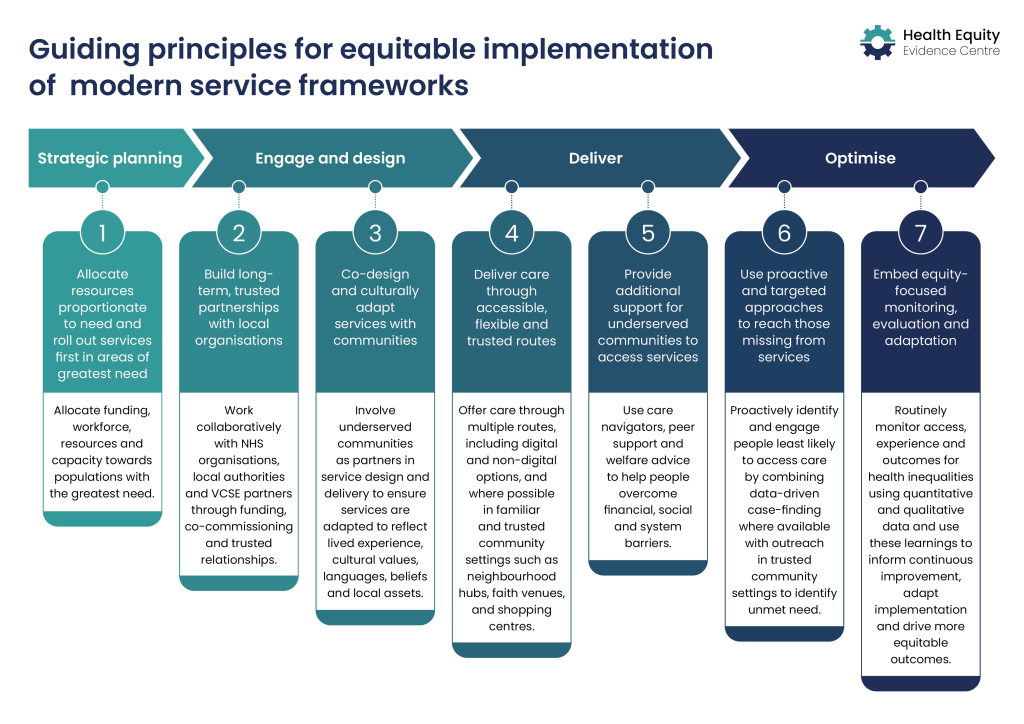
In this document, we present seven principles for equitable implementation of interventions, services and programmes. They reflect patterns in the evidence to help decision-makers understand what works and apply this while also taking into account contextual factors, such as the organisational landscape and governance structures.
Improving population health outcomes depends not only on effective interventions, services and programmes, but also on their effective implementation. Interventions shown to be effective in research studies, local areas or international contexts may fail to have the same real-world impact if implementation does not account for social, behavioural, cultural, economic and structural factors. Poorly designed implementation can also inadvertently exacerbate health and care inequalities through disproportionately improving access and care for those who already experience better health outcomes.
We present seven principles for equitable implementation of interventions, services and programmes. These principles have been drawn from a library of evidence briefs produced by the HEEC and are presented as themes, with the supporting evidence and case studies. They reflect patterns in the evidence to help decision-makers understand what works and apply this while also taking into account contextual factors, such as the organisational landscape and governance structures.
To successfully implement these principles, effective governance, capability and accountability are needed. Local systems should ensure governance, commissioning, workforce development and performance arrangements create the capacity and incentives to implement these principles consistently. This includes clear decision-making structures with partners, long-term funding mechanisms where needed, protected time and skills for co-design and outreach, and accountability for equity impacts.
Download the resources
Guiding principles for equitable implementation of Modern Service Frameworks
In this document we present seven principles for equitable implementation of interventions, services and programmes. These principles have been drawn from a library of evidence briefs produced by the HEEC and are presented as themes, with the supporting evidence and case studies. They reflect patterns in the evidence to help decision-makers understand what works and apply this while also taking into account contextual factors, such as the organisational landscape and governance structures. Download here
Equity matrix for equitable implementation of Modern Service Frameworks
In this document we set out an equity maturity matrix to support the seven evidence-informed guiding principles for equitable implementation of Modern Service Frameworks (MSFs) developed by the Health Equity Evidence Centre (HEEC). While developed to inform the cardiovascular disease (CVD) MSF, the maturity matrix is intentionally transferable, and intended to support equitable design, commissioning, delivery, improvement and evaluation across all MSFs and future public health initiatives. Download here.